
Eastern Michigan Athletics
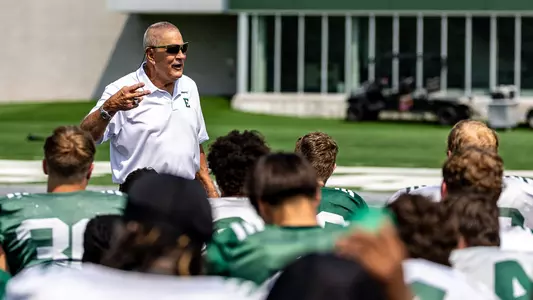
Photo by: Michael Vasilnek
One Shot, One Opportunity: John Banaszak Returns to Eastern Michigan
8/10/2026 6:01:00 PM | Football
Three-time Super Bowl champion returns to share lessons on opportunity, perseverance and growth
Purchase Tickets | Photo Gallery
YPSILANTI, Mich. (EMUEagles.com) — There are no practices for Eastern Michigan University football. There are opportunities. On Monday, Aug. 10, the Eagles were presented with Opportunity No. 10 of the 2026 season, another chance to compete, improve and take another step toward becoming the team they want to be when the season arrives. Watching from the sideline was someone who understands better than most what an opportunity can mean. John Banaszak, one of the most accomplished players in Eastern Michigan football history, returned to campus Monday to watch the team during their morning session before speaking with the team afterward, bringing with him a lifetime of lessons about football, preparation, perseverance and making the most of the chances placed in front of you.
For Banaszak, the visit was about much more than watching a football team prepare for a season. It was a return to the place that gave him his own opportunity nearly five decades ago, a place where he arrived after serving in the United States Marine Corps, and became a three-year starter at defensive end. At 76 years old, Banaszak has had a remarkable life in football, from Eastern Michigan to the Pittsburgh Steelers, from the legendary Steel Curtain defense to three Super Bowl championships and eventually to a long career in college coaching. Yet when he returned to Ypsilanti, it was clear that the Block E still carries a significance that time has not diminished.
"First of all, it's a pleasure to be here," Banaszak said. "I mean, I'm 76 years old." His words carried the perspective of someone who understands how quickly football careers and opportunities can pass, and his return to Eastern Michigan brought back memories that remain a daily part of his life. "Every day I look back and see something like in my office that has the Block E on it. And when you have the Block E on, everything changes as far as I was concerned. How I played, how I studied." For Banaszak, wearing the Block E was never simply about representing a university on a football field. It represented an opportunity to build something bigger than himself, both as a player and as a person.
Banaszak arrived at Eastern Michigan in January 1971 after his time in the Marine Corps, and football was not initially guaranteed to be part of his college experience. He wasn't attending school on a football scholarship, but his love for the game led him to try to walk onto the then-Hurons. He made the team, earned a full scholarship, and eventually became one of the most productive defensive players in program history, recording 237 career tackles, including 18 tackles for loss totaling 104 yards. By his senior season in 1974, Banaszak was a team captain and had earned the E.J. Rynearson Scholar-Athlete Award. "I was married in college. My wife and I got married early. My son was born here," Banaszak said. "There was a lot of pressure on me, both on the field and off the field, to be able to make sure you graduate from college. You've got to do it. Number one, I had to do it." He did, graduating from Eastern Michigan in 1975 with a bachelor's degree in Health, Physical Education and Recreation.
Then came another opportunity, one that might not have arrived if Banaszak had allowed the disappointment of going undrafted by the NFL to define him. The Pittsburgh Steelers signed him as a free agent, and Banaszak became one of only three rookies to make the team in 1975. He would go on to become part of one of the most dominant defenses in NFL history, playing on three Super Bowl championship teams, starting in Super Bowls XIII and XIV and earning Defensive Player of the Game honors in Super Bowl XIII after recording six tackles, two sacks and a fumble recovery against the Dallas Cowboys. But when Banaszak spoke to the Eagles Monday, he did not spend his time talking about Super Bowl rings or statistics. Instead, he talked about the mentality that made those accomplishments possible. "I operated under the premise of I only have one shot," Banaszak said. "One shot was all I had."
Because of his military experience, Banaszak entered the NFL as a 25-year-old rookie, older than many of the players around him and fully aware that he had to make his opportunity count. "I knew when I walked into Latrobe, Pennsylvania at St. Vincent College that I could not have a bad day," he said. That mindset became a source of internal motivation as he worked his way through the depth chart and established himself in Pittsburgh. His own journey stands as proof that the path to the NFL does not always begin at one of the nation's biggest programs. He believes the Mid-American Conference helped shape the players who came through it, particularly during an era when the league carried a different national profile. "When you look back and study the conference, how many great players came out of this conference?"
That belief was reinforced during Banaszak's years with the Steelers, where he played alongside some of the greatest defensive players in NFL history, including Joe Greene and L.C. Greenwood. "I played with some of the greatest players that ever played a game," he said. "I think that's one of the reasons why I made it is because they had to work." With opponents forced to account for stars such as Greene and Greenwood, Banaszak found opportunities to make an impact himself. "The opponent had to be concerned about Joe Green and L.C. Greenwood. They were going to leave me alone." It was a lighthearted comment, but it reflected the confidence and self-awareness that had carried Banaszak throughout his career.
Nearly 50 years after his playing days at Eastern Michigan, Banaszak could see just how much the university has changed. Standing along the sideline at Rynearson Stadium, he looked out at a campus and football facility that would have been difficult for his younger self to imagine. "The entire campus has exploded," Banaszak said. "But that's 45 years ago now. And sure, you need to advance the programs, and they've done a great job of doing that and building this facility." The stadium may look different, but the feeling of being on the field remains familiar. "Playing on this field is really an amazing thing for me because it's easier to sit up there and watch a game than it is on the field," he said. "And they've done a great job with it."
Banaszak has also followed the program under Head Coach Chris Creighton and has developed tremendous respect for what Creighton has built at Eastern Michigan. Having spent much of his own post-playing career coaching college football, Banaszak recognizes the demands that come with leading young players, and what stands out to him about Creighton is the energy he brings to that responsibility. "I'll tell you what. There is no one, no coach that I ever met that had that energy that Coach Creighton has for his team, for his players," Banaszak said. "And that's important right there." Banaszak knows coaching is about more than schemes and game plans. It is about relationships, accountability and understanding how to reach players when things don't go perfectly.
That perspective shaped what Banaszak saw during Monday morning's Opportunity No. 10. He wasn't simply watching drills; he was watching young men learn how to respond to the inevitable highs and lows that come with football. His own coaching career included time as an assistant and head coach at Washington & Jefferson College, where his teams went 38-9 from 1999-2002, and he earned Presidents' Athletic Conference Coach of the Year honors four consecutive times, before continuing his career at Robert Morris. For Banaszak, the answer to developing players begins with the simplest part of the process: getting better every time you step onto the field.
"You know, it's certainly, and I'll go back to some of the stuff I said earlier, a basic situation where you have to get better every time you walk on this field," Banaszak said. "In order for this football team to win, every one of these players has to walk out with that attitude that we're going to be better today. One day at a time." He also understands that young players will inevitably have difficult days, and that one poor performance can sometimes become much bigger in a player's mind than it needs to be. "Kids might have a bad practice and go into the tank," he said. "And he's in the tank, and he's not responding to how you're coaching him. But he's still a great player." The challenge for coaches and teammates, he explained, is helping that player move forward rather than allowing one difficult moment to define him. "You've got to be able to break that down. You've got to be able to put your arm around him and shake him up a little bit."
At one point during his time with the Eagles, Banaszak joked that he would love to put his hand in the dirt one more time against the current team. The comment drew a smile, but anyone listening could hear that the competitive fire remains. At 76, he still talks about football like someone who has a game coming up, and watching Opportunity No. 10 clearly brought back the feeling of being a player. The difference now is that his role has changed. Instead of being the young man fighting for his place on the depth chart, he is the veteran standing outside the lines, trying to give the next generation the perspective he gained through nearly six decades in and around the sport.
That is what made Monday's visit so meaningful. Banaszak returned to the place where his own opportunity began and spent the morning watching another group of Eagles pursue theirs. His journey from a Marine Corps veteran and Eastern Michigan walk-on to an E-Club Athletic Hall of Fame inductee, three-time Super Bowl champion and longtime college coach is proof that careers rarely follow a straight line. Sometimes the biggest opportunities begin with simply showing up and asking for a chance, and sometimes the most important part of an opportunity is what you choose to do with it once it arrives.
For the Eagles, Monday was Opportunity No. 10. There will be more to come, and Banaszak knows better than most that every one of them matters. He left the team with the same mentality that helped carry him from Ypsilanti to Pittsburgh and beyond: don't waste the chance in front of you, don't allow a bad day to define you, and understand that improvement is a daily responsibility. "You have to get better every time you walk on this field," Banaszak said. Nearly 50 years after he first wore the Block E, Banaszak returned to remind the current Eagles that the uniform may change, the stadium may change, and the game may change, but the opportunity to become better never does.
YPSILANTI, Mich. (EMUEagles.com) — There are no practices for Eastern Michigan University football. There are opportunities. On Monday, Aug. 10, the Eagles were presented with Opportunity No. 10 of the 2026 season, another chance to compete, improve and take another step toward becoming the team they want to be when the season arrives. Watching from the sideline was someone who understands better than most what an opportunity can mean. John Banaszak, one of the most accomplished players in Eastern Michigan football history, returned to campus Monday to watch the team during their morning session before speaking with the team afterward, bringing with him a lifetime of lessons about football, preparation, perseverance and making the most of the chances placed in front of you.
For Banaszak, the visit was about much more than watching a football team prepare for a season. It was a return to the place that gave him his own opportunity nearly five decades ago, a place where he arrived after serving in the United States Marine Corps, and became a three-year starter at defensive end. At 76 years old, Banaszak has had a remarkable life in football, from Eastern Michigan to the Pittsburgh Steelers, from the legendary Steel Curtain defense to three Super Bowl championships and eventually to a long career in college coaching. Yet when he returned to Ypsilanti, it was clear that the Block E still carries a significance that time has not diminished.
"First of all, it's a pleasure to be here," Banaszak said. "I mean, I'm 76 years old." His words carried the perspective of someone who understands how quickly football careers and opportunities can pass, and his return to Eastern Michigan brought back memories that remain a daily part of his life. "Every day I look back and see something like in my office that has the Block E on it. And when you have the Block E on, everything changes as far as I was concerned. How I played, how I studied." For Banaszak, wearing the Block E was never simply about representing a university on a football field. It represented an opportunity to build something bigger than himself, both as a player and as a person.
Banaszak arrived at Eastern Michigan in January 1971 after his time in the Marine Corps, and football was not initially guaranteed to be part of his college experience. He wasn't attending school on a football scholarship, but his love for the game led him to try to walk onto the then-Hurons. He made the team, earned a full scholarship, and eventually became one of the most productive defensive players in program history, recording 237 career tackles, including 18 tackles for loss totaling 104 yards. By his senior season in 1974, Banaszak was a team captain and had earned the E.J. Rynearson Scholar-Athlete Award. "I was married in college. My wife and I got married early. My son was born here," Banaszak said. "There was a lot of pressure on me, both on the field and off the field, to be able to make sure you graduate from college. You've got to do it. Number one, I had to do it." He did, graduating from Eastern Michigan in 1975 with a bachelor's degree in Health, Physical Education and Recreation.
Then came another opportunity, one that might not have arrived if Banaszak had allowed the disappointment of going undrafted by the NFL to define him. The Pittsburgh Steelers signed him as a free agent, and Banaszak became one of only three rookies to make the team in 1975. He would go on to become part of one of the most dominant defenses in NFL history, playing on three Super Bowl championship teams, starting in Super Bowls XIII and XIV and earning Defensive Player of the Game honors in Super Bowl XIII after recording six tackles, two sacks and a fumble recovery against the Dallas Cowboys. But when Banaszak spoke to the Eagles Monday, he did not spend his time talking about Super Bowl rings or statistics. Instead, he talked about the mentality that made those accomplishments possible. "I operated under the premise of I only have one shot," Banaszak said. "One shot was all I had."
Because of his military experience, Banaszak entered the NFL as a 25-year-old rookie, older than many of the players around him and fully aware that he had to make his opportunity count. "I knew when I walked into Latrobe, Pennsylvania at St. Vincent College that I could not have a bad day," he said. That mindset became a source of internal motivation as he worked his way through the depth chart and established himself in Pittsburgh. His own journey stands as proof that the path to the NFL does not always begin at one of the nation's biggest programs. He believes the Mid-American Conference helped shape the players who came through it, particularly during an era when the league carried a different national profile. "When you look back and study the conference, how many great players came out of this conference?"
That belief was reinforced during Banaszak's years with the Steelers, where he played alongside some of the greatest defensive players in NFL history, including Joe Greene and L.C. Greenwood. "I played with some of the greatest players that ever played a game," he said. "I think that's one of the reasons why I made it is because they had to work." With opponents forced to account for stars such as Greene and Greenwood, Banaszak found opportunities to make an impact himself. "The opponent had to be concerned about Joe Green and L.C. Greenwood. They were going to leave me alone." It was a lighthearted comment, but it reflected the confidence and self-awareness that had carried Banaszak throughout his career.
Nearly 50 years after his playing days at Eastern Michigan, Banaszak could see just how much the university has changed. Standing along the sideline at Rynearson Stadium, he looked out at a campus and football facility that would have been difficult for his younger self to imagine. "The entire campus has exploded," Banaszak said. "But that's 45 years ago now. And sure, you need to advance the programs, and they've done a great job of doing that and building this facility." The stadium may look different, but the feeling of being on the field remains familiar. "Playing on this field is really an amazing thing for me because it's easier to sit up there and watch a game than it is on the field," he said. "And they've done a great job with it."
Banaszak has also followed the program under Head Coach Chris Creighton and has developed tremendous respect for what Creighton has built at Eastern Michigan. Having spent much of his own post-playing career coaching college football, Banaszak recognizes the demands that come with leading young players, and what stands out to him about Creighton is the energy he brings to that responsibility. "I'll tell you what. There is no one, no coach that I ever met that had that energy that Coach Creighton has for his team, for his players," Banaszak said. "And that's important right there." Banaszak knows coaching is about more than schemes and game plans. It is about relationships, accountability and understanding how to reach players when things don't go perfectly.
That perspective shaped what Banaszak saw during Monday morning's Opportunity No. 10. He wasn't simply watching drills; he was watching young men learn how to respond to the inevitable highs and lows that come with football. His own coaching career included time as an assistant and head coach at Washington & Jefferson College, where his teams went 38-9 from 1999-2002, and he earned Presidents' Athletic Conference Coach of the Year honors four consecutive times, before continuing his career at Robert Morris. For Banaszak, the answer to developing players begins with the simplest part of the process: getting better every time you step onto the field.
"You know, it's certainly, and I'll go back to some of the stuff I said earlier, a basic situation where you have to get better every time you walk on this field," Banaszak said. "In order for this football team to win, every one of these players has to walk out with that attitude that we're going to be better today. One day at a time." He also understands that young players will inevitably have difficult days, and that one poor performance can sometimes become much bigger in a player's mind than it needs to be. "Kids might have a bad practice and go into the tank," he said. "And he's in the tank, and he's not responding to how you're coaching him. But he's still a great player." The challenge for coaches and teammates, he explained, is helping that player move forward rather than allowing one difficult moment to define him. "You've got to be able to break that down. You've got to be able to put your arm around him and shake him up a little bit."
At one point during his time with the Eagles, Banaszak joked that he would love to put his hand in the dirt one more time against the current team. The comment drew a smile, but anyone listening could hear that the competitive fire remains. At 76, he still talks about football like someone who has a game coming up, and watching Opportunity No. 10 clearly brought back the feeling of being a player. The difference now is that his role has changed. Instead of being the young man fighting for his place on the depth chart, he is the veteran standing outside the lines, trying to give the next generation the perspective he gained through nearly six decades in and around the sport.
That is what made Monday's visit so meaningful. Banaszak returned to the place where his own opportunity began and spent the morning watching another group of Eagles pursue theirs. His journey from a Marine Corps veteran and Eastern Michigan walk-on to an E-Club Athletic Hall of Fame inductee, three-time Super Bowl champion and longtime college coach is proof that careers rarely follow a straight line. Sometimes the biggest opportunities begin with simply showing up and asking for a chance, and sometimes the most important part of an opportunity is what you choose to do with it once it arrives.
For the Eagles, Monday was Opportunity No. 10. There will be more to come, and Banaszak knows better than most that every one of them matters. He left the team with the same mentality that helped carry him from Ypsilanti to Pittsburgh and beyond: don't waste the chance in front of you, don't allow a bad day to define you, and understand that improvement is a daily responsibility. "You have to get better every time you walk on this field," Banaszak said. Nearly 50 years after he first wore the Block E, Banaszak returned to remind the current Eagles that the uniform may change, the stadium may change, and the game may change, but the opportunity to become better never does.

Sunday, September 27
Saturday, September 26
Saturday, September 26
Saturday, September 26