
Eastern Michigan Athletics
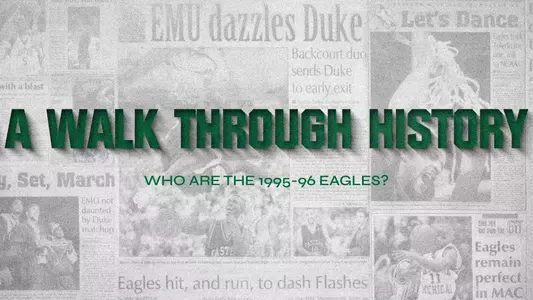
A Walk Through History: Who Are The 1995-96 Eagles?
4/1/2026 9:58:00 AM | Men's Basketball
By T.C. Cameron
YPSILANTI, Mich. (EMUEagles.com) -- On the way to historic success, the 1995-96 Eastern Michigan Eagles marched individually on a path less traveled to Ypsilanti.
Assembled by equal parts choice and chance, they're an eclectic collection of basketball players, and they became some of the most accomplished in program history, too.
Their 25-6 record nearly set the program record for wins. In the 1990s, a Mid-American Conference school needed two and perhaps three players of NBA-level talent on its roster to win the league, and Eastern's 14–4 MAC record in the MAC proves as much. The team that stomped Texas Tech and Duke, beat Rutgers on the road, and swept three games from defending champ Ball State, also absorbed losses to Bowling Green, Kent State, Miami, and Ohio. The expectations for the 1995-96 team were cemented by a returning roster accounting for 67 percent of the minutes played and 72 percent of the scoring from the year before. In 1995-96, Eastern averaged 84 points per game, good for the 12th-best nationally among roughly 350 Division I programs.
The core of the team was anchored by two seniors, Brian Tolbert and Theron Wilson, recruited to EMU in the shadows of the Fab Five, the most heralded recruiting class in college basketball history. Starring at Detroit St. Martin DePorres, Tolbert could score the basketball from anywhere in the front court and defend from the perimeter to the end line. "Brian was more of a point guard, but he was also a really good shooting guard, and he could score from anywhere on the floor," said former Detroit News prep writer Tom Markowski, who often covered EMU outside of his preps coverage circuit.
Wilson was part of a family legacy from Detroit's Martin Luther King High School, but it was decided after his sophomore year the 6-foot-9 swingman would transfer to Royal Oak Dondero and live with John Bancroft's family in Royal Oak, Michigan. Late in Wilson's recruiting cycle, Michigan State entered the fray among dozens of competing schools, but Wilson stayed true to EMU. When Wilson called MSU head coach Jud Heathcote to tell him the decision to go to Eastern, Heathcote told him he was making a mistake and hung up the phone.
"That was an example of how cutthroat the recruiting game was back then, because coaches could tell you anything you wanted to hear, but when they didn't get the answer they wanted, they could tear you into pieces," Wilson remembered. "It was Mr. Bancroft — who was like second father to me — who said, 'Theron, you weren't supposed to go to MSU; you belong at Eastern.'"
Sophomore Earl Boykins, arguably the program's greatest modern-day player — George Gervin, Grant Long, and Kennedy McIntosh being the other alums worthy of that prestigious title — and Derrick Dial, a 6-foot-6 guard from Detroit Cass Tech, rounded out the Eagles' headliners.
Boykins had been under-recruited out of Cleveland Catholic Central, but had proven to be a pesky defender who threatened every competitor's decision on offense, and a water bug with the ball, darting and dashing around defenders of any size.
Dial was unique because he could play as a big guard or small forward. He landed at EMU as a walk- on with an academic award during his freshman season. "Even though we didn't have a scholarship to offer, Derrick still wore a shirt and tie on his campus visit," Ben Braun said. "The respect he showed for our basketball program and the university as an institution moved us to ensure he could come to school on an academic award before moving him to an athletic scholarship."
Torrey Mills, the younger brother of former Michigan big man Terry Mills, and the nephew of Grant Long on his father's side and John Long on his mother's side, transferred to Eastern after two productive seasons at Central Michigan. Before the current Transfer Portal era, it was universally considered taboo to transfer to a rival school. "Torrey's vertical jump was something I've never seen before or after," Tolbert said. "One time, he was standing on the sideline, slipped on his shoes, took a step, dribbled, lifted off on two steps, and dunked the ball with two hands. Remember, this was from the sideline, not the end line, and he hadn't even laced up his shoes.
Jon Zajac was a 6-foot-7 forward who first signed with Central Michigan, but when CMU unceremoniously fired its coach, he pivoted to Buffalo. A year later, transferred back home to EMU. "Redshirting really helped me a great deal," Zajac said. "I had to mature physically and mentally, by working hard in the weight room, building skills on the floor, and competing with and against this amazing team in practices."
From the East Coast came Todd Beeten and Charlie Eibeler. Beeten was a 6-foot-2 guard and a coach's son — his father, Scott, was the top assistant at George Washington University under Mike Jarvis — and he'd scored 1,000 points at Maret School, located just blocks from the National Cathedral and one of about 40 well-to-do prep schools in and around the DMV (that's the District of Columbia, and surrounding suburbs of Maryland and Virginia).
Beeten's good friend and AAU teammate was Charlie Eibeler, a rugged 6-foot-3 forward from pint- sized Milltown, New Jersey, where the annual Fourth of July parade resembles what you'd expect to see in the movie "Hoosiers." Eibeler chose Eastern over Canisius.
James Head, an All-State selection from Plymouth Salem, was originally headed for Iowa, but an NCAA Clearinghouse issue unintentionally reopened his recruitment. "James played for Bob Brodie, and most of Salem's opponents never saw someone as athletic and strong as James," Markowski recalled. "He averaged between 15 and 20 points a game, but those totals would have been much higher had he played under a coach trying to push the ball down the court aggressively." The international flavor was provided by three players not easily found on any other school's recruiting radar.
Nkechi Ezugwu, a Nigerian who graduated from Sycamore High School in Cincinnati, was discovered by assistant coach Brian Miller, who convinced the coaching staff the bruising 6-foot-8 forward could be a solid contributor off the bench.
From Israel came Timi Berkovitch, a sharp-shooting 6-foot-4 guard discovered by Braun while coaching the American Jewish National team in the Maccabiah Games.
Mick Pennisi came from Australia via Beeten's father, Scott, who was among the first college coaches to successfully recruit international players into the American collegiate game.
A hat tip also goes to Howard Chambers, who played on Braun's 1987-88 MAC Championship team, and told the staff about Pennisi while he was playing professionally in Australia. Rounding out the roster was Fred Reynolds, a walk-on freshman from Houston's Episcopal High School.
The 1995-96 Eagles were poised for big things, but they would have to face an arduous schedule unlike any Eastern team had played before or since to succeed.
Author T.C. Cameron is a 1995 graduate of Eastern Michigan University. As EMU's preeminent athletics historian, he has crafted the definitive record of the people and moments that have shaped EMU athletics over the past 50 years. A native of Royal Oak, MI, Cameron now lives in Lowes Island, Va., after 16 years in Annapolis, Md.
Assembled by equal parts choice and chance, they're an eclectic collection of basketball players, and they became some of the most accomplished in program history, too.
Their 25-6 record nearly set the program record for wins. In the 1990s, a Mid-American Conference school needed two and perhaps three players of NBA-level talent on its roster to win the league, and Eastern's 14–4 MAC record in the MAC proves as much. The team that stomped Texas Tech and Duke, beat Rutgers on the road, and swept three games from defending champ Ball State, also absorbed losses to Bowling Green, Kent State, Miami, and Ohio. The expectations for the 1995-96 team were cemented by a returning roster accounting for 67 percent of the minutes played and 72 percent of the scoring from the year before. In 1995-96, Eastern averaged 84 points per game, good for the 12th-best nationally among roughly 350 Division I programs.
The core of the team was anchored by two seniors, Brian Tolbert and Theron Wilson, recruited to EMU in the shadows of the Fab Five, the most heralded recruiting class in college basketball history. Starring at Detroit St. Martin DePorres, Tolbert could score the basketball from anywhere in the front court and defend from the perimeter to the end line. "Brian was more of a point guard, but he was also a really good shooting guard, and he could score from anywhere on the floor," said former Detroit News prep writer Tom Markowski, who often covered EMU outside of his preps coverage circuit.
Wilson was part of a family legacy from Detroit's Martin Luther King High School, but it was decided after his sophomore year the 6-foot-9 swingman would transfer to Royal Oak Dondero and live with John Bancroft's family in Royal Oak, Michigan. Late in Wilson's recruiting cycle, Michigan State entered the fray among dozens of competing schools, but Wilson stayed true to EMU. When Wilson called MSU head coach Jud Heathcote to tell him the decision to go to Eastern, Heathcote told him he was making a mistake and hung up the phone.
"That was an example of how cutthroat the recruiting game was back then, because coaches could tell you anything you wanted to hear, but when they didn't get the answer they wanted, they could tear you into pieces," Wilson remembered. "It was Mr. Bancroft — who was like second father to me — who said, 'Theron, you weren't supposed to go to MSU; you belong at Eastern.'"
Sophomore Earl Boykins, arguably the program's greatest modern-day player — George Gervin, Grant Long, and Kennedy McIntosh being the other alums worthy of that prestigious title — and Derrick Dial, a 6-foot-6 guard from Detroit Cass Tech, rounded out the Eagles' headliners.
Boykins had been under-recruited out of Cleveland Catholic Central, but had proven to be a pesky defender who threatened every competitor's decision on offense, and a water bug with the ball, darting and dashing around defenders of any size.
Dial was unique because he could play as a big guard or small forward. He landed at EMU as a walk- on with an academic award during his freshman season. "Even though we didn't have a scholarship to offer, Derrick still wore a shirt and tie on his campus visit," Ben Braun said. "The respect he showed for our basketball program and the university as an institution moved us to ensure he could come to school on an academic award before moving him to an athletic scholarship."
Torrey Mills, the younger brother of former Michigan big man Terry Mills, and the nephew of Grant Long on his father's side and John Long on his mother's side, transferred to Eastern after two productive seasons at Central Michigan. Before the current Transfer Portal era, it was universally considered taboo to transfer to a rival school. "Torrey's vertical jump was something I've never seen before or after," Tolbert said. "One time, he was standing on the sideline, slipped on his shoes, took a step, dribbled, lifted off on two steps, and dunked the ball with two hands. Remember, this was from the sideline, not the end line, and he hadn't even laced up his shoes.
Jon Zajac was a 6-foot-7 forward who first signed with Central Michigan, but when CMU unceremoniously fired its coach, he pivoted to Buffalo. A year later, transferred back home to EMU. "Redshirting really helped me a great deal," Zajac said. "I had to mature physically and mentally, by working hard in the weight room, building skills on the floor, and competing with and against this amazing team in practices."
From the East Coast came Todd Beeten and Charlie Eibeler. Beeten was a 6-foot-2 guard and a coach's son — his father, Scott, was the top assistant at George Washington University under Mike Jarvis — and he'd scored 1,000 points at Maret School, located just blocks from the National Cathedral and one of about 40 well-to-do prep schools in and around the DMV (that's the District of Columbia, and surrounding suburbs of Maryland and Virginia).
Beeten's good friend and AAU teammate was Charlie Eibeler, a rugged 6-foot-3 forward from pint- sized Milltown, New Jersey, where the annual Fourth of July parade resembles what you'd expect to see in the movie "Hoosiers." Eibeler chose Eastern over Canisius.
James Head, an All-State selection from Plymouth Salem, was originally headed for Iowa, but an NCAA Clearinghouse issue unintentionally reopened his recruitment. "James played for Bob Brodie, and most of Salem's opponents never saw someone as athletic and strong as James," Markowski recalled. "He averaged between 15 and 20 points a game, but those totals would have been much higher had he played under a coach trying to push the ball down the court aggressively." The international flavor was provided by three players not easily found on any other school's recruiting radar.
Nkechi Ezugwu, a Nigerian who graduated from Sycamore High School in Cincinnati, was discovered by assistant coach Brian Miller, who convinced the coaching staff the bruising 6-foot-8 forward could be a solid contributor off the bench.
From Israel came Timi Berkovitch, a sharp-shooting 6-foot-4 guard discovered by Braun while coaching the American Jewish National team in the Maccabiah Games.
Mick Pennisi came from Australia via Beeten's father, Scott, who was among the first college coaches to successfully recruit international players into the American collegiate game.
A hat tip also goes to Howard Chambers, who played on Braun's 1987-88 MAC Championship team, and told the staff about Pennisi while he was playing professionally in Australia. Rounding out the roster was Fred Reynolds, a walk-on freshman from Houston's Episcopal High School.
The 1995-96 Eagles were poised for big things, but they would have to face an arduous schedule unlike any Eastern team had played before or since to succeed.
Author T.C. Cameron is a 1995 graduate of Eastern Michigan University. As EMU's preeminent athletics historian, he has crafted the definitive record of the people and moments that have shaped EMU athletics over the past 50 years. A native of Royal Oak, MI, Cameron now lives in Lowes Island, Va., after 16 years in Annapolis, Md.


Saturday, August 22
Wednesday, May 27
Wednesday, May 27
Tuesday, April 21