
Eastern Michigan Athletics
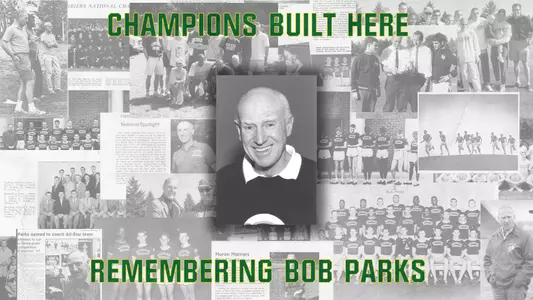
Remembering Bob Parks: Week 2
3/16/2021 11:18:00 AM | Men's XC, Men's Track & Field, General
Rise to national powerhouse: 1967-1969
YPSILANTI, Mich. (EMUEagles.com) -- With the hiring of President Dr. Harold Sponberg in 1965, Athletic Director F.L. "Frosty" Ferzacca in 1966, and Bob Parks in 1967, Michigan State Normal College transitioned into Eastern Michigan University and ushered in a new-found emphasis on athletic excellence. From the start, Parks laid the foundation for a championship-caliber program:
"I found out right away that there were people on the team that were not used to practicing regularly and some of these were on scholarship, a situation that was going to end right away," said Bob Parks. "My immediate mission was to elevate the level of competition and raise everyone's goals."
That season, EMU saw two transfers make their way to Ypsi: Jerry Cerulla and Ralph Stephenson. Cerulla had been the NCAA champion in the high hurdles in 1966 at Utah State but left the Beehive State to be closer to family in Wyandotte, Mich. Stephenson was a former student-athlete under Parks at Thurston High School and Western Michigan, finally joining his coach at EMU. At WMU, Stephenson had won the MAC 880-yard title.
At the NAIA championships, Eastern placed third with Texas Southern claiming the top spot. Distance runner Terry Norman won the 1000-yard run in a then-meet record time of 2:13.0 and later anchored the two-mile relay team to victory.
During this time, Parks had been working on signed big-time recruit Bill Tipton. Tipton was a Pontiac Central product, the same high school of former EMU grad and Olympic champion, Hayes Jones. Parks ultimately landed the highly-ranked national recruit, which Parks believed was the catalyst for building the championship culture at Eastern that still exists today:
"It may even be to this day, the biggest recruiting catch in school history for any sport," said Parks. This success opened the door to the landing of many other top prospects which got us going to 34 years of great success, to a level that, even I, sometimes couldn't believe."
Additionally, Parks would add another future Olympian in Canadian distance runner David Ellis. Ellis, alongside teammates Charlton Baldwin and Dick Reamer earned All-American status during the 1967 cross country season.
In 1968, success continued for Parks as he gathered more stars and led his teams in high-level meets. At the time, football standout Dave Pureifory took a shot at track & field, participating in the shot put. Pureifory went on to be EMU's first three-time All-American in football and spent a decade in the National Football League with the Green Bay Packers, Cincinnati Bengals, and Detroit Lions.
Being affiliated with the NCAA College Division (now called Division II) and the NAIA, EMU chose not to compete at the 1968 indoor championships at Cobo Hall in Detroit, Mich. Villanova earned the indoor title, beating out a USC squad led by O.J. Simpson.
For the 1968 outdoor season, Eastern practiced on the rubber-asphalt track five miles away at Concordia College. The new track was finished on EMU's campus but was surrounded by a sea of mud at the time.
At the Kentucky Relays, pole vaulter Bill Barrett registered a then-varsity and Michigan Collegiate record in the event, reaching a height of 16' 0.25" (4.88m). Later in the season, on the first Saturday of May, Eastern finally hosted an open meet on the inaugural track named after Lloyd W. Olds and George Marshall.
Olds was a member of EMU's faculty for 42 years and was a coach, athletic director, and head of intramurals. He is credited with creating the black and white striped referee shirts we still see today.
In the final meet of the regular season, Eastern hosted the U.S. Track & Field Federation State Outdoor Championships. At the meet, EMU was outstanding in the mile relay as Pat Bynoe, Jim Wicker, Jimmy Grant, Ralph Stephenson created an excellent pace, winning the event in a then-school record time of 3:11.1.
For the NAIA outdoor championships, Parks took a team of five men to the University of New Mexico. In the high hurdles, Eastern went 1-2 as Curella grabbed first (13.7) and Tipton second (13.9). In the 5000m run, Ellis got off to a slow start but found a new gear on the last lap, crossing the finish line in 14:25.5 time for a then-stadium record. EMU (42 points) finished in third overall, falling to first-place Prairie View A&M (47), and runner-up Arkansas AM&N (now the University of Arkansas at Pine Bluff) (45). All in all, the varsity track & field team finished with a 13-2 record.
Unfortunately, Marshall, who had been ill for years with emphysema, passed away. Marshall coached cross country and track & field from 1928-1965, won 14 total Central Collegiate Conference championships, earned the NAIA XC title in 1966, coached former Eagle Hayes Jones who won the 110m hurdles in the 1964 Olympics in Tokyo, Japan. In 1968, Marshall was inducted into the NAIA Hall of Fame.
In the fall of 1968, Eastern would be without its star runner David Ellis. That year, the summer Olympics took place in October, thus Ellis was training and competing in Mexico City, Mexico. At the Games, he represented Canada in the 5000m and 10000m run. Nevertheless, Parks held his cross country team accountable in Ellis's absence, running time trials of the harriers to weed out those who hadn't performed their summer workouts.
Meanwhile, there was a war going on in Vietnam. In 1968, the U.S. conflict in the Vietnam War had grown out of control, leading graduate assistant Ron Warhurst to leave his position and join the U.S. Marine Corps. Warhurst had been an incredibly successful cross country runner for Parks at Western Michigan as a member of the Broncos' 1964 and 1965 national championship teams. He performed a one-year tour of Vietnam, parachuting behind enemy lines in the Arizona territory, regarded as one of the toughest areas to fight in the country. He was awarded two Purple Hearts and a Navy Achievement Medal Citation during his service.
After the war, the University of Michigan hired Warhurst to lead the Wolverines' men's cross country team and served as track and field head coach for nine years. He ultimately coached U of M to seven Big Ten Championships between 1974-2009, with 21 student-athletes achieving All-American status.
In EMU's second cross country meet of the season, the harriers hosted Ball State behind Bowen Field House. Though the Cardinals pulled out the win, 36-23, Eastern's course had a special charm to it: "It was pretty neat. The students would lean out their windows, yelling encouragement to the runners, and one guy would play the Lone Ranger theme song on his stereo as they went by," said Parks. "We attracted a lot of fans right there on campus and I think it made our guys run to their potential."
At the Notre Dame Invitational, Parks and his team took the program to another level, winning the meet over high-caliber programs such as Western Michigan and Michigan. Good news came later in the season as Ellis became eligible after wrapping up his time with Canada's Olympic team. The team flew to Oklahoma City, Okla. for the 1968 NAIA title race, running on a recently-plowed cornfield. Ellis came in second as EMU (126 points) took third overall, falling to runner-up Emporia State (110), and title-winner Fort Hays (106). The Canadian Olympian was named an All-American for the second time in his career.
The indoor season was met with some turbulence as Eastern had plane trouble getting to the NAIA championships in Kansas City, Mo. The winter weather had delayed their early morning departure from O'Hare International Airport, but eventually made their way to the Show-Me State later in the evening, just before the start of the championships. Once they touched-down in KC, the team had to change in the taxis on the way to the meet. EMU blew away the competition despite the travel issues, with Bill Tipton and Bobby Lynn finishing first and second in the high hurdles, respectively.
Later in the season, Eastern rolled through the State NAIA meet, boasting a 177-point victory compared to runner-up Ferris State's 58.5, sweeping the podium in nine events. Despite the positive performances over the last few meets, there was an anticlimactic end to the indoor season.
EMU qualified five student-athletes for the 1969 NCAA meet in Detroit's Cobo Hall. However, poor showings and one runner missing his ride from Ypsilanti resulted in a less than stellar display from Eastern. But the team set its sights on the outdoor season.
While optimistic about the outdoor slate, EMU was hit with bad luck, seemingly all at once. Tipton, the star hurdler, was out with appendicitis. Meanwhile, several other team members were riddled with injuries, some left the team to focus on studies, Pureifory returned the gridiron for spring football, and one Finnish jumper flew back to Finland without saying a word.
Timing continued to be an issue as the team once again had trouble arriving at a meet on time, this time for a meet in Muncie, Ind. against host Ball State and Taylor: "We decided to go down and back the same day to save money and it was a long trip" said Parks. "We took a bus and it was very slow, plus we thought we had gained an hour on the time change, but were shocked when we saw a clock and realized that we were getting there just as the meet was supposed to be starting."
EMU shook out its bus legs, however, dominating in the field events and winning a number of track events as well including a podium sweep in the 440-yard dash. At the meet, Ellis set a new track record three-mile run of 14:01.42, 41 seconds ahead of the closest competitor.
Eastern then headed out west for the NAIA Championships in Billings, Mont. At the national meet, Ellis captured both the six-mile (30:10.4) and the three-mile (13:55.2) crown, as the team finished in third place.
In three short years at the helm of Eastern Michigan University's cross country and track & field programs, Coach Bob Parks had achieved national recognition and set the tone for years to come. In the 1970s, the teams continued to compete at the highest level, and saw more greats don the Green and Yellow, like Gordon Minty.
Be sure to follow along in the following weeks as we continue to take a deep dive into Bob Parks' legacy at Eastern Michigan University.
"I found out right away that there were people on the team that were not used to practicing regularly and some of these were on scholarship, a situation that was going to end right away," said Bob Parks. "My immediate mission was to elevate the level of competition and raise everyone's goals."
That season, EMU saw two transfers make their way to Ypsi: Jerry Cerulla and Ralph Stephenson. Cerulla had been the NCAA champion in the high hurdles in 1966 at Utah State but left the Beehive State to be closer to family in Wyandotte, Mich. Stephenson was a former student-athlete under Parks at Thurston High School and Western Michigan, finally joining his coach at EMU. At WMU, Stephenson had won the MAC 880-yard title.
At the NAIA championships, Eastern placed third with Texas Southern claiming the top spot. Distance runner Terry Norman won the 1000-yard run in a then-meet record time of 2:13.0 and later anchored the two-mile relay team to victory.
During this time, Parks had been working on signed big-time recruit Bill Tipton. Tipton was a Pontiac Central product, the same high school of former EMU grad and Olympic champion, Hayes Jones. Parks ultimately landed the highly-ranked national recruit, which Parks believed was the catalyst for building the championship culture at Eastern that still exists today:
"It may even be to this day, the biggest recruiting catch in school history for any sport," said Parks. This success opened the door to the landing of many other top prospects which got us going to 34 years of great success, to a level that, even I, sometimes couldn't believe."
Additionally, Parks would add another future Olympian in Canadian distance runner David Ellis. Ellis, alongside teammates Charlton Baldwin and Dick Reamer earned All-American status during the 1967 cross country season.
In 1968, success continued for Parks as he gathered more stars and led his teams in high-level meets. At the time, football standout Dave Pureifory took a shot at track & field, participating in the shot put. Pureifory went on to be EMU's first three-time All-American in football and spent a decade in the National Football League with the Green Bay Packers, Cincinnati Bengals, and Detroit Lions.
Being affiliated with the NCAA College Division (now called Division II) and the NAIA, EMU chose not to compete at the 1968 indoor championships at Cobo Hall in Detroit, Mich. Villanova earned the indoor title, beating out a USC squad led by O.J. Simpson.
For the 1968 outdoor season, Eastern practiced on the rubber-asphalt track five miles away at Concordia College. The new track was finished on EMU's campus but was surrounded by a sea of mud at the time.
At the Kentucky Relays, pole vaulter Bill Barrett registered a then-varsity and Michigan Collegiate record in the event, reaching a height of 16' 0.25" (4.88m). Later in the season, on the first Saturday of May, Eastern finally hosted an open meet on the inaugural track named after Lloyd W. Olds and George Marshall.
Olds was a member of EMU's faculty for 42 years and was a coach, athletic director, and head of intramurals. He is credited with creating the black and white striped referee shirts we still see today.
In the final meet of the regular season, Eastern hosted the U.S. Track & Field Federation State Outdoor Championships. At the meet, EMU was outstanding in the mile relay as Pat Bynoe, Jim Wicker, Jimmy Grant, Ralph Stephenson created an excellent pace, winning the event in a then-school record time of 3:11.1.
For the NAIA outdoor championships, Parks took a team of five men to the University of New Mexico. In the high hurdles, Eastern went 1-2 as Curella grabbed first (13.7) and Tipton second (13.9). In the 5000m run, Ellis got off to a slow start but found a new gear on the last lap, crossing the finish line in 14:25.5 time for a then-stadium record. EMU (42 points) finished in third overall, falling to first-place Prairie View A&M (47), and runner-up Arkansas AM&N (now the University of Arkansas at Pine Bluff) (45). All in all, the varsity track & field team finished with a 13-2 record.
Unfortunately, Marshall, who had been ill for years with emphysema, passed away. Marshall coached cross country and track & field from 1928-1965, won 14 total Central Collegiate Conference championships, earned the NAIA XC title in 1966, coached former Eagle Hayes Jones who won the 110m hurdles in the 1964 Olympics in Tokyo, Japan. In 1968, Marshall was inducted into the NAIA Hall of Fame.
In the fall of 1968, Eastern would be without its star runner David Ellis. That year, the summer Olympics took place in October, thus Ellis was training and competing in Mexico City, Mexico. At the Games, he represented Canada in the 5000m and 10000m run. Nevertheless, Parks held his cross country team accountable in Ellis's absence, running time trials of the harriers to weed out those who hadn't performed their summer workouts.
Meanwhile, there was a war going on in Vietnam. In 1968, the U.S. conflict in the Vietnam War had grown out of control, leading graduate assistant Ron Warhurst to leave his position and join the U.S. Marine Corps. Warhurst had been an incredibly successful cross country runner for Parks at Western Michigan as a member of the Broncos' 1964 and 1965 national championship teams. He performed a one-year tour of Vietnam, parachuting behind enemy lines in the Arizona territory, regarded as one of the toughest areas to fight in the country. He was awarded two Purple Hearts and a Navy Achievement Medal Citation during his service.
After the war, the University of Michigan hired Warhurst to lead the Wolverines' men's cross country team and served as track and field head coach for nine years. He ultimately coached U of M to seven Big Ten Championships between 1974-2009, with 21 student-athletes achieving All-American status.
In EMU's second cross country meet of the season, the harriers hosted Ball State behind Bowen Field House. Though the Cardinals pulled out the win, 36-23, Eastern's course had a special charm to it: "It was pretty neat. The students would lean out their windows, yelling encouragement to the runners, and one guy would play the Lone Ranger theme song on his stereo as they went by," said Parks. "We attracted a lot of fans right there on campus and I think it made our guys run to their potential."
At the Notre Dame Invitational, Parks and his team took the program to another level, winning the meet over high-caliber programs such as Western Michigan and Michigan. Good news came later in the season as Ellis became eligible after wrapping up his time with Canada's Olympic team. The team flew to Oklahoma City, Okla. for the 1968 NAIA title race, running on a recently-plowed cornfield. Ellis came in second as EMU (126 points) took third overall, falling to runner-up Emporia State (110), and title-winner Fort Hays (106). The Canadian Olympian was named an All-American for the second time in his career.
The indoor season was met with some turbulence as Eastern had plane trouble getting to the NAIA championships in Kansas City, Mo. The winter weather had delayed their early morning departure from O'Hare International Airport, but eventually made their way to the Show-Me State later in the evening, just before the start of the championships. Once they touched-down in KC, the team had to change in the taxis on the way to the meet. EMU blew away the competition despite the travel issues, with Bill Tipton and Bobby Lynn finishing first and second in the high hurdles, respectively.
Later in the season, Eastern rolled through the State NAIA meet, boasting a 177-point victory compared to runner-up Ferris State's 58.5, sweeping the podium in nine events. Despite the positive performances over the last few meets, there was an anticlimactic end to the indoor season.
EMU qualified five student-athletes for the 1969 NCAA meet in Detroit's Cobo Hall. However, poor showings and one runner missing his ride from Ypsilanti resulted in a less than stellar display from Eastern. But the team set its sights on the outdoor season.
While optimistic about the outdoor slate, EMU was hit with bad luck, seemingly all at once. Tipton, the star hurdler, was out with appendicitis. Meanwhile, several other team members were riddled with injuries, some left the team to focus on studies, Pureifory returned the gridiron for spring football, and one Finnish jumper flew back to Finland without saying a word.
Timing continued to be an issue as the team once again had trouble arriving at a meet on time, this time for a meet in Muncie, Ind. against host Ball State and Taylor: "We decided to go down and back the same day to save money and it was a long trip" said Parks. "We took a bus and it was very slow, plus we thought we had gained an hour on the time change, but were shocked when we saw a clock and realized that we were getting there just as the meet was supposed to be starting."
EMU shook out its bus legs, however, dominating in the field events and winning a number of track events as well including a podium sweep in the 440-yard dash. At the meet, Ellis set a new track record three-mile run of 14:01.42, 41 seconds ahead of the closest competitor.
Eastern then headed out west for the NAIA Championships in Billings, Mont. At the national meet, Ellis captured both the six-mile (30:10.4) and the three-mile (13:55.2) crown, as the team finished in third place.
In three short years at the helm of Eastern Michigan University's cross country and track & field programs, Coach Bob Parks had achieved national recognition and set the tone for years to come. In the 1970s, the teams continued to compete at the highest level, and saw more greats don the Green and Yellow, like Gordon Minty.
Be sure to follow along in the following weeks as we continue to take a deep dive into Bob Parks' legacy at Eastern Michigan University.

Thank You from EMU Cross Country/Track & Field!
Monday, December 01
Giving Tuesday 2025 - EMU Cross Country/Track & Field
Monday, December 01
Giving Tuesday 2025 - Eastern Michigan Track & Field
Monday, December 01
2025 E-Club Athletic Hall of Fame Ceremony
Saturday, October 11