
Eastern Michigan Athletics
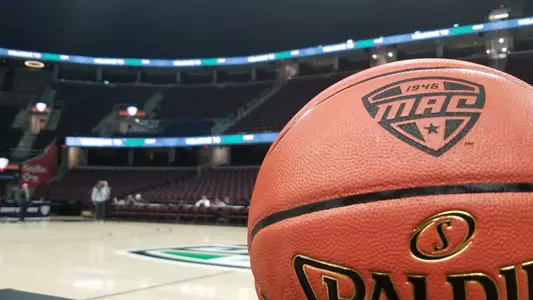
MAC Cancels Remainder of 2020 MAC Basketball Tournament
3/12/2020 12:40:00 PM | Women's Basketball, General
The main priority of the MAC continues to be the health, safety and wellness of our student-athletes and coaches
Scott_Wetherbee Audio | MAC Press Conference Audio.
CLEVELAND, Ohio (EMUEagles.com) -- The Mid-American Conference announced today, March 12, that it will be canceling the remainder of the Men's and Women's Basketball Tournament at Rocket Mortgage Fieldhouse, effective immediately.
"Breaking the news to coach Fred Castro, it was heartbreaking to do that, but they (the team) understand" said Eastern Michigan University Vice President and Director of Athletics Scott Wetherbee. "This is where life is bigger than athletics and one game, and we have to keep that in mind."
The MAC will use this time to work with the appropriate medical experts and institutional leadership to determine next steps for moving forward in regard to the COVID-19 pandemic.
The main priority of the Mid-American Conference continues to be the health, safety, and wellness of our student-athletes, coaches, administrators, fans and media as we continue to monitor all developing and relevant information on the COVID-19 virus.
MAC Press Conference
Dr. Jon Steinbrecher, Mid-American Conference Commissioner
Len Komoroski, Rocket Mortgage FieldHouse CEO
DR. JON STEINBRECHER: Good morning, or good afternoon I guess it is now.
We have been meeting all morning with our directors of athletics, with our presidents, talking about what is the appropriate path forward. We've also been paying attention to what is going on around us both in the world at large and the sports world, and as you started to see this morning, you've seen another ‑‑ a number of conferences have made the decision to cancel. We have come to the same conclusion and we are cancelling our event.
It is incredibly disappointing in terms of the kids having a chance to compete further because I know this is a pinnacle event and is something they look forward to, but simply from a public health standpoint, this seems the appropriate course of action.
Take questions.
Q. Jon, I take it then you were full go up until maybe an hour or two ago?
DR. JON STEINBRECHER: Yeah, we've been going around all morning, so yeah. And it's been fluid all morning, but I just fairly recently made the decision that it would be appropriate to no longer continue the event and I would say this has been done in consultation with our presidents and directors of athletics.
Q. Did you consult with any other conferences about their decisions leading up to this morning, checking on what they're doing so this can be a collective decision?
DR. JON STEINBRECHER: Yeah, we've been in communication for well over a week on different actions people were taking. Clearly we stepped out early on some procedures we were implementing for our tournament and then today ‑‑ last night and then today unfolded. We're taking temperatures of what was going on around us as well, but at the end of the day it's a decision we have to make.
Q. Jon, as you know, two players were recently diagnosed with Coronavirus. Were any of the teams using the NBA facilities here in the building?
DR. JON STEINBRECHER: Yes.
Q. What's going to be the protocol for those teams that use those facilities like locker rooms?
DR. JON STEINBRECHER: And I'm going to ask Len Komoroski, CEO of the Cleveland Cavaliers, to assist me with that, but let me walk you through what we've done as soon as we got information on that.
First thing we did was, okay, where would players have been, participants have been. Went back, generated records on cleaning, what occurred there and how many times it had been cleaned. We're talking a period of really eight, nine, 10 days.
So what we're hearing, and I had discussions this morning with the director of the Cleveland Board of Health as well as the Cuyahoga County Board of Health and they both were confident with the fact that given the cleaning regimen and the distance between when the Utah players were in the facility, that that shouldn't pose a point of view.
We had made the decision that if we would have moved forward, we were going to close down that locker room and not utilize it anymore even though we didn't believe there was a risk posed by that.
Then we had begun discussion ‑‑ discussing implementing perhaps further protocols, medical protocols, screening protocols with our student‑athletes and we're discussing that as we ultimately came to a decision. And then I'll let Len wade in with perhaps some other information that sheds more light on this.
LEN KOMOROSKI: Yes, as Jon referred to, we go through an extensive sanitation process after every event. There were actually five events that occurred since the Jazz were in town prior to the MAC conference coming here as well, so that process has been repeated continually throughout that, not to mention when the usage is actually taking place by the MAC.
Beyond that as well, the timeline obviously with the affected player with the Jazz, from what we're understanding based on incubation period and actually where symptoms appear and given the length of time from when the Jazz were in town, which was March 2nd, until when last night occurred, would suggest that the risk was very low that the affected player actually had contracted it and had that while he was in Cleveland.
DR. JON STEINBRECHER: The additional point of discovery we went through was were there any people involved in the operation of our event that could have had a direct line of contact with that player. There were none. All of our backstage people were different than what was occurring in and around the NBA event. So based on the science of it, we felt very comfortable that we were in a reasonable spot.
Q. In regards to the NCAA Tournament, what kind of conversations have you had with the governing body, will that tournament happen next week? What has been your read from the national level?
DR. JON STEINBRECHER: Yeah, I don't have an answer on that. We have been in fairly constant communication with them yesterday as planning was going on to hold the NCAA event and they announced they would move forward with the limited spectator thing. Obviously they were in touch with us as we were slated to host next week on just general operational ideas. We implemented procedures around it and they were looking at some feedback on how our event was going. So Jeff Bacon on our staff spent a significant amount of time with those folks yesterday. We have no information on what their decisions might be going forward. I would direct those to the NCAA.
Q. If the national tournament happens, who's the (inaudible)?
DR. JON STEINBRECHER: Our automatic qualifiers would revert back to the regular season champions.
Q. I guess historically has this ever happened? And also if you could tell us, how do you feel at this point, because this is unprecedented?
DR. JON STEINBRECHER: I have no knowledge of a similar type of situation at least on this scale. I'm sure conferences have dealt with various things from time to time, but to have the nationwide, in fact worldwide issue we're all dealing with right now, I don't know.
How do I feel? I don't even know how to answer that. You know what, you're working the problem, you're working the issue. We're concerned with making sure we do everything possible to mitigate risk factors for our students and for our student‑athletes and for our fans and anyone interacting in and around our programs.
So that's ‑‑ I don't know that I feel. I'm focused on that's the job right now, that's the job of our presidents, that's the job of our directors of athletics and all of us involved in this enterprise.
Q. You mentioned that the regular season winner would represent at the NCAA Tournament. Assuming that tournament does go on, will you have any say or will you have any input of the school as to whether or not you want them to pull away as a result of the Coronavirus or would that be at their discretion?
DR. JON STEINBRECHER: Well, as we move forward, I'm sure schools will have various conversations on that. A lot of what will dictate this moving forward, we're starting to see we're having state, county, city rules and regulations starting to come into say. As we're all public institutions, we're having state regulations or mandates coming down on to types of behaviors, on whether or not people can travel. I think all of those things will go into consideration. Ultimately the institutions will have to make some decisions on what they do going forward.
Q. With the NBA news last night, were there any protocols instituted this morning for the two teams scheduled to play, Akron and Ohio? Were any medical checks done, were any protocols adhered to?
DR. JON STEINBRECHER: Yeah, and part of the reason that we started to implement a delay and we were starting to begin those, our schools have been doing various checks anyway, but we were implementing a little more formalized health check, whether it's temperature, and I don't have in front of me the protocols of the other things to occur, as well as we were going to have the athletics director or designee visit individually with each student‑athlete and ask whether they were comfortable competing or not. So we had the students to have a voice to continue in this on whether or not they wanted to continue.
Q. So personal checks and diagnostic ‑‑
DR. JON STEINBRECHER: Now, how far down the road we were getting on that, I don't know. That's where we were headed. If we continued, those were going to be put in place.
Q. Beyond basketball, have you made a determination on spring sports?
DR. JON STEINBRECHER: We have not. We had a brief discussion today, but most of the discussion was on basketball. Those discussions will continue. I hope we come to some conclusions on that within the next couple of days.
Q. The safety of players and fans notwithstanding, was there any thought going forward of what to do for some of the workers who won't be able to help partake in this economic driver for the city, and that's including folks working at the arena, park attendants, et cetera?
DR. JON STEINBRECHER: Yeah, we have not weighed into that at this point in time. I've in fact got an AD's meeting coming up and we've got a laundry list of things we've got to talk about.
You know what, we're disappointed on a lot of levels, obviously first and foremost for the student‑athletes and our fans. We're disappointed about the fact this event has been a pretty significant economic driver within this community and acknowledge that.
And let's face it, we're going through an event right now that's going to cause interesting issues with regards to that. I won't claim to know what we're going to do, but acknowledge that there's a lot of people hurting.
LEN KOMOROSKI: As it pertains to our part‑time workers, ushers, ticket takers, security who would have otherwise worked the event, they will be compensated as if they had worked.
CLEVELAND, Ohio (EMUEagles.com) -- The Mid-American Conference announced today, March 12, that it will be canceling the remainder of the Men's and Women's Basketball Tournament at Rocket Mortgage Fieldhouse, effective immediately.
"Breaking the news to coach Fred Castro, it was heartbreaking to do that, but they (the team) understand" said Eastern Michigan University Vice President and Director of Athletics Scott Wetherbee. "This is where life is bigger than athletics and one game, and we have to keep that in mind."
The MAC will use this time to work with the appropriate medical experts and institutional leadership to determine next steps for moving forward in regard to the COVID-19 pandemic.
The main priority of the Mid-American Conference continues to be the health, safety, and wellness of our student-athletes, coaches, administrators, fans and media as we continue to monitor all developing and relevant information on the COVID-19 virus.
MAC Press Conference
Dr. Jon Steinbrecher, Mid-American Conference Commissioner
Len Komoroski, Rocket Mortgage FieldHouse CEO
DR. JON STEINBRECHER: Good morning, or good afternoon I guess it is now.
We have been meeting all morning with our directors of athletics, with our presidents, talking about what is the appropriate path forward. We've also been paying attention to what is going on around us both in the world at large and the sports world, and as you started to see this morning, you've seen another ‑‑ a number of conferences have made the decision to cancel. We have come to the same conclusion and we are cancelling our event.
It is incredibly disappointing in terms of the kids having a chance to compete further because I know this is a pinnacle event and is something they look forward to, but simply from a public health standpoint, this seems the appropriate course of action.
Take questions.
Q. Jon, I take it then you were full go up until maybe an hour or two ago?
DR. JON STEINBRECHER: Yeah, we've been going around all morning, so yeah. And it's been fluid all morning, but I just fairly recently made the decision that it would be appropriate to no longer continue the event and I would say this has been done in consultation with our presidents and directors of athletics.
Q. Did you consult with any other conferences about their decisions leading up to this morning, checking on what they're doing so this can be a collective decision?
DR. JON STEINBRECHER: Yeah, we've been in communication for well over a week on different actions people were taking. Clearly we stepped out early on some procedures we were implementing for our tournament and then today ‑‑ last night and then today unfolded. We're taking temperatures of what was going on around us as well, but at the end of the day it's a decision we have to make.
Q. Jon, as you know, two players were recently diagnosed with Coronavirus. Were any of the teams using the NBA facilities here in the building?
DR. JON STEINBRECHER: Yes.
Q. What's going to be the protocol for those teams that use those facilities like locker rooms?
DR. JON STEINBRECHER: And I'm going to ask Len Komoroski, CEO of the Cleveland Cavaliers, to assist me with that, but let me walk you through what we've done as soon as we got information on that.
First thing we did was, okay, where would players have been, participants have been. Went back, generated records on cleaning, what occurred there and how many times it had been cleaned. We're talking a period of really eight, nine, 10 days.
So what we're hearing, and I had discussions this morning with the director of the Cleveland Board of Health as well as the Cuyahoga County Board of Health and they both were confident with the fact that given the cleaning regimen and the distance between when the Utah players were in the facility, that that shouldn't pose a point of view.
We had made the decision that if we would have moved forward, we were going to close down that locker room and not utilize it anymore even though we didn't believe there was a risk posed by that.
Then we had begun discussion ‑‑ discussing implementing perhaps further protocols, medical protocols, screening protocols with our student‑athletes and we're discussing that as we ultimately came to a decision. And then I'll let Len wade in with perhaps some other information that sheds more light on this.
LEN KOMOROSKI: Yes, as Jon referred to, we go through an extensive sanitation process after every event. There were actually five events that occurred since the Jazz were in town prior to the MAC conference coming here as well, so that process has been repeated continually throughout that, not to mention when the usage is actually taking place by the MAC.
Beyond that as well, the timeline obviously with the affected player with the Jazz, from what we're understanding based on incubation period and actually where symptoms appear and given the length of time from when the Jazz were in town, which was March 2nd, until when last night occurred, would suggest that the risk was very low that the affected player actually had contracted it and had that while he was in Cleveland.
DR. JON STEINBRECHER: The additional point of discovery we went through was were there any people involved in the operation of our event that could have had a direct line of contact with that player. There were none. All of our backstage people were different than what was occurring in and around the NBA event. So based on the science of it, we felt very comfortable that we were in a reasonable spot.
Q. In regards to the NCAA Tournament, what kind of conversations have you had with the governing body, will that tournament happen next week? What has been your read from the national level?
DR. JON STEINBRECHER: Yeah, I don't have an answer on that. We have been in fairly constant communication with them yesterday as planning was going on to hold the NCAA event and they announced they would move forward with the limited spectator thing. Obviously they were in touch with us as we were slated to host next week on just general operational ideas. We implemented procedures around it and they were looking at some feedback on how our event was going. So Jeff Bacon on our staff spent a significant amount of time with those folks yesterday. We have no information on what their decisions might be going forward. I would direct those to the NCAA.
Q. If the national tournament happens, who's the (inaudible)?
DR. JON STEINBRECHER: Our automatic qualifiers would revert back to the regular season champions.
Q. I guess historically has this ever happened? And also if you could tell us, how do you feel at this point, because this is unprecedented?
DR. JON STEINBRECHER: I have no knowledge of a similar type of situation at least on this scale. I'm sure conferences have dealt with various things from time to time, but to have the nationwide, in fact worldwide issue we're all dealing with right now, I don't know.
How do I feel? I don't even know how to answer that. You know what, you're working the problem, you're working the issue. We're concerned with making sure we do everything possible to mitigate risk factors for our students and for our student‑athletes and for our fans and anyone interacting in and around our programs.
So that's ‑‑ I don't know that I feel. I'm focused on that's the job right now, that's the job of our presidents, that's the job of our directors of athletics and all of us involved in this enterprise.
Q. You mentioned that the regular season winner would represent at the NCAA Tournament. Assuming that tournament does go on, will you have any say or will you have any input of the school as to whether or not you want them to pull away as a result of the Coronavirus or would that be at their discretion?
DR. JON STEINBRECHER: Well, as we move forward, I'm sure schools will have various conversations on that. A lot of what will dictate this moving forward, we're starting to see we're having state, county, city rules and regulations starting to come into say. As we're all public institutions, we're having state regulations or mandates coming down on to types of behaviors, on whether or not people can travel. I think all of those things will go into consideration. Ultimately the institutions will have to make some decisions on what they do going forward.
Q. With the NBA news last night, were there any protocols instituted this morning for the two teams scheduled to play, Akron and Ohio? Were any medical checks done, were any protocols adhered to?
DR. JON STEINBRECHER: Yeah, and part of the reason that we started to implement a delay and we were starting to begin those, our schools have been doing various checks anyway, but we were implementing a little more formalized health check, whether it's temperature, and I don't have in front of me the protocols of the other things to occur, as well as we were going to have the athletics director or designee visit individually with each student‑athlete and ask whether they were comfortable competing or not. So we had the students to have a voice to continue in this on whether or not they wanted to continue.
Q. So personal checks and diagnostic ‑‑
DR. JON STEINBRECHER: Now, how far down the road we were getting on that, I don't know. That's where we were headed. If we continued, those were going to be put in place.
Q. Beyond basketball, have you made a determination on spring sports?
DR. JON STEINBRECHER: We have not. We had a brief discussion today, but most of the discussion was on basketball. Those discussions will continue. I hope we come to some conclusions on that within the next couple of days.
Q. The safety of players and fans notwithstanding, was there any thought going forward of what to do for some of the workers who won't be able to help partake in this economic driver for the city, and that's including folks working at the arena, park attendants, et cetera?
DR. JON STEINBRECHER: Yeah, we have not weighed into that at this point in time. I've in fact got an AD's meeting coming up and we've got a laundry list of things we've got to talk about.
You know what, we're disappointed on a lot of levels, obviously first and foremost for the student‑athletes and our fans. We're disappointed about the fact this event has been a pretty significant economic driver within this community and acknowledge that.
And let's face it, we're going through an event right now that's going to cause interesting issues with regards to that. I won't claim to know what we're going to do, but acknowledge that there's a lot of people hurting.
LEN KOMOROSKI: As it pertains to our part‑time workers, ushers, ticket takers, security who would have otherwise worked the event, they will be compensated as if they had worked.

2025–26 Career Summit Series Part 1
Monday, December 22
Fernanda Ovalle Career-Highs 22 points and Five Assists at Ball State Highlights
Saturday, December 20
That time of year again!🔒😤
Thursday, December 18
UK Gymnast Tries American Fast Food For The First Time
Wednesday, December 17